I spent twenty years reading and posting and never finishing anything. This fall I built a system, with Claude, that turns my arguments into published pieces. When a detector says a piece is AI-written, it's measuring the sentences. This is an account of everything the sentences sit on top of, and most of it is me.
Vikas ErraballiAbout 15 min
The problem
I had the raw material of a writer and none of the output. Fifteen years of Kindle highlights, Evernote notes going back to 2009, a few thousand saved articles, and about 22,000 Facebook posts and comments, many of them first drafts of essays I never wrote. What I didn't have was a finishing process. And the obvious shortcut had a trap in it: readers now run a piece through a detector, get a number, and stop reading. I understand the reflex. Most of what the detectors catch is a thesis fed to a model and posted. But the number measures the sentences, and the sentences are the last and smallest part of a piece. So the goal was a system that keeps the thinking mine and makes it visible: the model does research, fact-checking and the twenty boring checks, and I do the part a detector can't see, which is deciding what's true and arguing with the draft until it is.
This is an experiment, and the system is still changing week to week. What follows is how it's put together, with the Florida Senate piece as the worked example. Florida was the first time the system had to hold up under a real argument: five drafts in a day, and every draft taught it something. One piece proves very little, though, and I'll come back to what would.
A memex, eighty years late
None of this started with AI. In July 1945 Vannevar Bush, who had run American science through the war, published "As We May Think" in The Atlantic and described a desk he called the memex: a private library on microfilm, fast enough to consult that it would be "an enlarged intimate supplement to his memory." His complaint was that libraries are indexed by alphabet and class, and minds aren't. "The human mind does not work that way. It operates by association." So the memex let its owner tie any two items together, build named trails through everything he'd read, write his own notes into the trail, and pull the whole trail up years later in the middle of a conversation. "The process of tying two items together is the important thing."
I came to the essay late. A month after the 2016 election I sent four friends a write-up for what I called a civic platform. It would sit one layer above Snopes and PolitiFact, where people you already trust do the fact-checking they'd be doing anyway and organize it for everyone else. Facts would be kept apart from views, each issue would be a page maintained like a Wikipedia entry, and from any page you could cross over to how another group saw the same issue, "to allow for cross-pollination of opposing views, synthesis when possible."
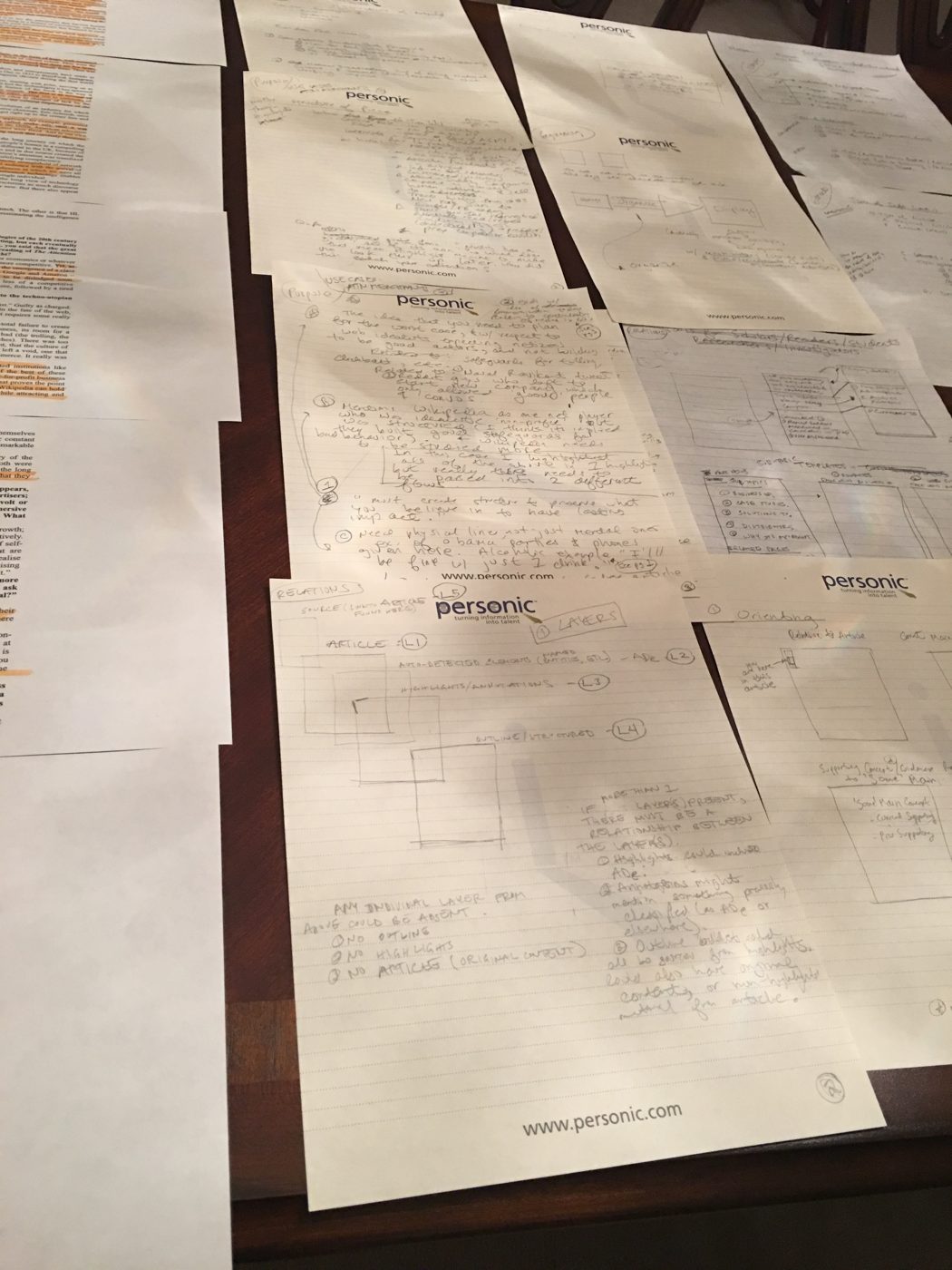
A month later, with a highlighted printout of Tim Wu's The Attention Merchants on the dining table, I sketched the reading half on a dozen notepad pages. Every article would carry five layers you could switch on and off: the article itself, the names and entities a machine could pick out of it, my highlights and annotations, an outline sorted from those highlights, and its relations to everything else I'd read. Any layer could be missing. The line I wrote at the bottom of the page was the one that mattered: "If more than 1 layer(s) present there must be a relationship between the layer(s)." I posted a photo of the pages the next day, with a caption about laying the layers out in space instead of scrolling one screen: "See the whole, not just a piece."
Fig 1 · The 2017 pagesNotepad, Jan 10, 2017
Five layers, sketched on a dining table in January 2017
The pages as I photographed them on January 10, 2017. Front: the five layers. Behind: "orienting" (you are here in this article, and the evidence for and against its main idea), relations, and my notes on Wu's book.
By late January I had a note that read "Essays should be able to talk to each other, or too much replication of effort," and another saying the tool should aim at Adler's ideal of dialectical objectivity: "To look at all sides and take no sides." In February, introducing myself to a group working on the same problem, I wrote that I'd been designing "something I saw later originally conceived of by Vannevar Bush." That fall I was trading notes on the layers with a group planning the fiftieth anniversary of Douglas Engelbart's 1968 demo, the line that runs from Bush's desk to the hyperlink.
Over the next few years I drew up schemas and built prototypes of the same thing: a library where the articles talk to each other, where my annotations sit on the page the way Hypothesis lets you mark up the web, and where citing a source while I write takes one step. Every version stalled on the same problem Bush's design had. Someone has to make each link between two items by hand, and I was never going to make ten thousand links on the chance I'd need one.
What changed is that the hand labor is gone. A model can search my highlights by idea instead of by keyword, which is the closest thing yet to Bush's selection by association, and it can connect a nine-year-old clipping to tonight's draft in the time it takes me to ask. The library this system runs on is the memex I kept sketching, with the one part Bush couldn't mechanize filled in.
Fig 2 · Memex to system1945 · 2017 · 2026
Every part Bush described now exists, including the one nobody could staff
Left: "As We May Think" (1945). Middle: the January 2017 pages. Right: the part of this system that does the job now.
Memex, 1945
My pages, 2017
This system, 2026
"all his books, records, and communications"
L1 Articlethe text itself
Reading libraryKindle and Audible highlights, Evernote since 2009, saved links, and twenty years of my own writing
"selection by association"
L2 Auto-detected elementsnames and entities a machine picks out
Search by ideathe model finds passages by what they mean, not the words they use
"He can add marginal notes and comments"
L3 Highlights and annotations
Quote bankone file per book, my highlights with my margin notes beside them
L4 Outlinesorted from the highlights
Drafting skillthe thesis, the lens and the outline, built from my reading
trails, named and kept, through "the maze of materials"
L5 Relationssources, topics, evidence for and against
Commonplace book and frameworksideas filed by theme; nine lenses, each with the questions it makes me ask
"a new profession of trail blazers"
Nobodythe layers had to be built by hand The missing part
Research agents and methe model walks the trails at speed; I decide which ones the argument needs
The 2017 rule, that any two layers present must link to each other, is now the rule that every claim in a piece links to its source. The part neither Bush nor I could mechanize was the reader who builds the trail for you.
There's one more note from that stretch, and I'd forgotten writing it. In February 2019, twelve days after OpenAI announced GPT-2, I was reading its answers to test prompts and wrote that if machine text flooded the environment, my filter would let in less, and that the tool worth building was one that flags the original idea in the flood. Further down the page I wrote that "anything that could be generated by AI, should be, leaving humans to do better things." That's the division of labor this account describes, set down almost four years before ChatGPT by someone with no idea how to build it. The same note predicted that sensemaking would co-evolve with efforts to confuse it. The detector and the prose it grades are one arms race, and I'm not entering it.
Source material first
The first practical decision was that a writer's references should come from what he has actually read. That sounds obvious, but the default behavior of any model is to reach for the quote everyone reaches for. So before any writing, I consolidated everything into one place: the Kindle and Audible highlights, the Goodreads and Amazon lists, the Evernote archive, the saved links from four platforms, even screenshots of book pages from my phone. From that came a quote bank, one file per book with my highlights and margin notes; a commonplace book of ideas by theme; and a sheet of every author I've engaged with, tiered by how much I trust them. The rule the system follows: a quote earns its place only if it sharpens the argument, it must come from a book I've read or own, and three references is usually the ceiling.
Fig 3 · The partsWhat feeds what
Everything upstream of a piece is mine
The reading library feeds three guides, which feed the drafting skill. The model reads all of it; it doesn't invent it.
Scroll sideways for the full diagram →
The three guides are the system's memory of me. The corrections log is how they change.
Source: the system as builtAs of Nov 4, 2026 · ¶ fig 3
Three guides, three jobs
A model that knows your reading still writes in its own voice, so the second layer is three guides it reads before every draft. The voice guide was mined from my own writing: the moves that are mine (analogy as the main argument, mechanism before morality, stated odds with the reason behind them, a credential worn lightly) and the habits I wanted to lose (sarcasm as a rebuttal, contempt words, stacked rhetorical questions). The craft guide is how a piece works, built from the writing advice I had saved for fifteen years without ever applying: Palahniuk on received text, Mamet's boredom test, Roy Peter Clark on aiming a long sentence at one word. Every rule names its source. The frameworks guide is the one I'm proudest of. It's how I think: the nine analytical lenses I got from the books that changed how I see the world, each with the questions it makes me ask. The voice guide is how I sound. This one is why my pieces aren't interchangeable with anyone else's.
The voice guide has an odd origin. In October, getting ready to put my own name on my Facebook account, I went through twenty years of it: four thousand posts archived, thirteen thousand comments read one at a time. Anything strident or sarcastic went, whatever the topic. Reading all of it to decide what to hide turned out to be the best map I'll get of how I argue. The same pass that flagged the sarcasm pulled out 1,300 places where I'd explained something, answered pushback, made the other side's case or changed my mind. The guide is built from the second list. The first list became its don'ts.
Two rules from the craft guide, as examples of the kind of thing that's in there:
Craft guideNo received text; invent your own. A phrase worn smooth by other writers ("wringing my hands") that the writer never actually pictured. If something has been described one way, find a new way, in terms only this writer would use. The same goes for aphorisms: coin the line only this piece could have.
Craft guideAim long sentences at one word. A long sentence works when it flies toward an emphatic final word. Put the payoff at the end.
The workflow for one piece
I send a thesis, sometimes two lines. The model finds the one-sentence version of what I'm saying, names the lens it runs on, checks every fact, searches my reading by idea rather than keyword, runs a reversal test and writes the strongest case against, then edits rather than rewrites. Then two passes I added after the first published piece came back sounding like a machine: a second read "as Vikas would," and a scan for the tells of model prose: signpost openers, a closer on every paragraph, "not X but Y" reversals, threes for rhythm, colon reveals, abstractions as characters. Any draft that fails those doesn't reach me.
That was the system on November 1. What happened over the next three days is the part worth writing about.
The Florida piece, draft by draft
The thesis of the Florida piece was simple: Chuck Schumer's committees spent nothing on Angie Nixon's Senate race in Florida, she lost by under three points, and that was a decision rather than an oversight. Here's what each draft changed, and what the system learned.
Fig 4 · Five drafts in a dayFlorida piece · Nov 4
Every draft taught the system a new rule
What my notes caught in each version, and the rule each one became.
v1
Written from a two-line thesis. The research found the best evidence for the case: the committees moved money into Kansas and Mississippi in October and never into Florida.Lens: how power works. Check: 35 races, not "hundreds".
v2
A style test. I'd asked which writers I might learn from (Sam Kriss, Gore Vidal), so the draft planted its one conceit, "priced at zero," in the opening and closed on it. Four paragraphs changed. Then I ran it through an AI detector: 100 percent.Detector: 100% AI Fair enough; the model typed the sentences. Everything that made the piece worth reading hadn't happened yet.Lesson: the detector measures the typing. Show the rest.
v3
My line notes. The biggest: a sentence about the governor's race had its evidence pointing the wrong way. David Jolly, a centrist ex-Republican, had also been starved of national money and also lost narrowly. That doesn't show a ceiling money couldn't move; it shows the party wrote off the state. The piece reframed around it: Florida could have been a second Texas.New rule: does each comparison point the way the sentence says?
v4
My broader questions: how much money did the committees actually have, which other races did they skip, and is Florida unusual? Three research agents ran in parallel; a fourth, which hadn't seen the drafting, fact-checked the result and found thirteen errors. The pattern pointed at the state, not the nominee, which cost the piece its simplest version of the Israel argument and made it more honest.Rules: did they have the means? Is this case unusual or a pattern?
v5
A friend's critique: this is hindsight, Florida was close because the whole country moved. So the research computed the swing from 2024 in every red state. The funded ones moved 16 to 26 points; the country moved 13 to 15; Florida moved 10. South Carolina moved 22 on almost nothing, which the piece says too.Rule: is the defense weighed, and tested against the numbers?
Each draft was fact-checked against sources before I saw it. Each rule went into the guide the same day.
Source: drafts v1–v5 and the corrections logNov 4, 2026 · ¶ fig 4
Arguing with the draft
The thing I do that the system couldn't, at first, is read a draft the way a hostile, intelligent reader would and ask the questions that reader would ask. Are we putting words in Schumer's mouth? He never said that; Gillibrand did. Why is Ohio the comparison, when Maine, where the party spent $38 million against a senator in a state Harris carried, makes the point better? If the socialist label cost Nixon less than a point against the centrist, couldn't you say the lack of money cost her just as little? What would a $15 million buy have done to Republican spending in response? Every one of those questions made the piece better, and every one of them was a question I'd had to write by hand.
So the next move was the one that makes this a system rather than a chat: I asked for the questions to be performed before I see the draft. The craft guide now has a reader's pushback pass, fourteen questions answered and fixed on every handover, each of which came from a note I once had to make myself. The handover I get back lists what the pass changed, then only what needs me: judgment calls, personal lines, odds I have to own.
Fig 5 · The reader's pushback pass6 of 14 questions
Each standing question began as a note I wrote by hand
Six of the fourteen questions the pass runs on every draft, each with the Florida note it came from.
1
Does each comparison point the way the sentence says?
From: "Are we saying Jolly did get party support and still lost?" He hadn't. The sentence was reversed.
2
Are we putting words in anyone's mouth?
From: "Not sure Schumer would say that." He hadn't said anything; the draft now attributes the defense to Gillibrand, who had.
3
Is every number in context?
From: "What firepower did they actually have?" Answer: $354 million and $216 million raised; the ask was 3 percent of it.
4
Did they have the means, and is the defense weighed?
From: "How can Gillibrand say it needed Texas-sized money when Florida's spending was a third of that?" The piece now tests her claim against the numbers.
5
Is this case unusual, or part of a pattern?
From: "What other races did they choose not to help?" Florida was the only close race with zero; Southern long shots got small, late bets.
6
Does the reporting change the frame?
From: the Jolly finding. The piece was about Nixon; it became about Florida.
The last check comes from Mortimer Adler: a reader may disagree with an author only because he is uninformed, misinformed, illogical or incomplete. The pass ends by reading the draft as that critic.
Source: the craft guide; Adler, How to Read a BookAs of Nov 4, 2026 · ¶ fig 5
Scaling the work without losing the thread
By v4 the piece had a dozen factual threads and I started to worry about the obvious limit: one model, one context, trying to hold research, drafting and checking at once gets sloppy in exactly the way a tired writer does. The fix was division of labor. Each thread of research goes to its own agent with a clean slate and a narrow brief, and comes back as a short, sourced report. The draft is written from those reports. Then a separate agent that never saw the drafting checks every figure against the sources and reports what's wrong, problems first. The pushback pass runs on the whole draft at the end, because comparisons and framing only show up when you read the thing whole.
None of this is new. It's how a good magazine already works: reporters gather the facts, a writer drafts from their notes, a fact-checker who had no hand in the story checks every claim against the source, and an editor asks the questions a hostile reader would. Those roles exist because nobody, human or model, reliably catches their own mistakes. What's new is that I can staff every desk for a single op-ed at eleven at night. My job is the one at the top of the masthead: what the piece argues, and whether it runs.
Two desks stay human on purpose, mine and the outside reader's. A friend's hindsight objection did more for Florida than any agent, and I trust that desk for the reason the 2016 design trusted friends over websites. You can ask a friend what he's after.
Fig 6 · Division of laborOne draft, five desks
One op-ed, every desk of a newsroom
The desks a magazine has, each staffed by an agent with one job. The masthead job is mine.
Scroll sideways for the full diagram →
Each agent starts with a clean context and a narrow brief. The writer reads the reports, never the raw pages, and the fact-checker reads the draft cold.
The model is better than I am at four things: finding what the record actually says, holding thirty figures straight, catching my own tells, and running the same twenty checks on draft five that it ran on draft one without getting bored. It is worse than I am at the thing that matters more than the four: knowing what I think. The thesis was mine. The lens, marking to market, came from a trading floor I sat on. The reversal that rebuilt the piece came from a question I asked. The friend who said it was hindsight was mine, and so was the decision to put his objection in the piece and test it against the numbers rather than wave it off. The model typed the sentences, and I'll say so every time. But "who typed it" is a question about the last and smallest step. It tells you nothing about whether the Florida piece is right.
That's what I'd like this account to change. "AI-created" is doing a lot of work in people's heads right now: it means careless, it means generic, it means nobody checked. Those are real failures, and they're failures of process, not of tools. Here the process was five drafts, three research agents, an independent fact-check that found thirteen errors, fourteen standing questions, and a reader who wouldn't let a comparison stand if it pointed the wrong way. Judge the piece on whether the argument holds, and on whether you understand the race better for having read it. Adler, whose four grounds for disagreement already sit in the pushback pass, put one level of reading above all the others in How to Read a Book and called it syntopical: read everyone worth reading on a question, set them against each other, and come away with a view none of them hands you. That's the job the checks serve. A draft that survives them has earned the right to be argued with, and the arguing is how I find out whether I've gotten closer to true.
The part that compounds is the rule-extraction. Each time I make a correction that would apply to the next piece, it goes into a log as a before-and-after pair with the rule it teaches; the rule is stored in its general form, and the correction that produced it stays attached as the worked example. The system doesn't get smarter because the model does. It gets smarter because it keeps a record of every note I had to make by hand, so the next draft needs one fewer.
For anyone who wants to build the same thing, the parts are ordinary. The whole system is a Claude project. The guides are documents the model reads before every draft; the drafting procedure is a skill, a file of instructions; research and fact-checking run as separate agents with clean contexts; the quote bank and the corrections log are files in Drive. There is no custom software in the loop, and when a draft needs arithmetic, like the fifty-state swing table, the model writes and runs the code itself. The leverage is all in the rulebook, and in where the independence sits.
What I expect to break
Before asking how a position makes money, ask how it loses it. This system has a few obvious ways to fail, and most of them follow from how the models actually work, which is the part that usually gets skipped when people argue about whether AI can write. Knowing the mechanism tells you where to put the checks.
Fig 7 · Open risksMarked Nov 2026
Six ways this could fail, and the plan for each
Each one follows from how language models work, not from anything specific to writing.
1
The rulebook gets too long to follow
Every rule is text the model reads before it writes, and its attention over a long prompt isn't spread evenly. In one 2025 test, compliance fell steadily as the number of simultaneous instructions rose, and earlier work found models use what sits at the start and end of a long context better than what's buried in the middle. The pushback pass went from zero questions to fourteen in three days.
PlanTier the rules: a short core loaded every time, and the checklists run as separate passes by agents with one job each. Every so often, merge rules that say the same thing and cut the ones that never fire.
2
Long sessions forget
A model's working memory is its context window. When a session runs past it, the earlier conversation is compressed into a summary, and any detail the summary dropped is gone. The session that built this page ran out of room once and carried on from its own notes.
PlanNothing that matters lives only in the chat. Guides, the corrections log, drafts and sources are files the next session reads.
3
The model grades its own homework
A model checking a draft it just wrote shares the blind spots that produced it, and researchers have found models rate their own output more favorably than other text of the same quality. That's why the fact-checker never sees the drafting.
PlanMove the pushback pass out of the drafter's last step and into an agent of its own, the way the fact-check already is.
4
It agrees with me too easily
Models tuned on human ratings learn that agreement gets rated well, and the documented result is sycophancy, a pull toward telling the user what he wants to hear. In a system built around my pushback, that's the quiet failure: when my note is wrong, the draft may fold anyway.
PlanCheck my notes the way the draft gets checked, and have the handover say so when the system thinks I'm wrong.
5
The rules are fitted to one piece
Every question in the pushback pass came from Florida. Some of them are about argument in general. Some may turn out to be about Senate money in 2026.
PlanStore each rule in its general form, with the Florida note that produced it kept as the worked example. Log which rules fire on which pieces; one that never fires on the next five gets rewritten or cut.
6
The model underneath changes
The rules were written against one version of the model. A newer one may not need some of them and may misread others.
PlanKeep a test set, the Florida drafts and the before-and-after pairs from the corrections log, and rerun it whenever the model changes, the way you'd test code before a release. In the field this is called an eval.
Most of these are the same fix in different clothes: independent checks, and a book that gets re-marked when the market moves.
Source: studies linked in each itemAs of Nov 4, 2026 · ¶ fig 7
What's next
One piece is a single data point. The proof of the system will be in the next ten, and the measure I care about is whether each one needs fewer of my notes than the last, because that is what it looks like when the rules are capturing how I think. On the list: figures and citations in every piece, with every number checked by a fact-checking agent that had no part in writing the draft. A historical-analogues doc, because half of what I write is forecasting and the reading I do for it should be organized by the question it answers. And a prediction log, so I keep score, misses included.
The writing system is one half of those 2017 pages. The other half was for readers. My cousin, one of the four who got the 2016 write-up, read a draft of this page and went straight to it. Rap Genius put a crowd's annotations under every lyric, so put this machinery under everything else. Hover on a claim in Das Kapital and see the strongest objections and who made them. Hover on a line in a mayor's plan for city-run grocery stores and see how the idea has fared in the cities that tried one. That's the five layers with the staffing problem solved. Crowd annotation never scaled past lyrics because it needed Bush's "new profession of trail blazers," and nobody could pay for one. A model can do that job, and the pushback pass I run on my own drafts is the same pass a reader would want run on anything he reads. For now I'm pointing it at my own backlog.
And one open position to mark honestly, since the conceit of this site demands it: I can't yet show the system saves me time. Florida ate most of a day in notes, rebuttals and checks. The bet is that the rules compound and my notes thin out, so the tenth piece costs a fraction of the first. If the tenth piece still takes a day of my pushback, then this is a very elaborate way of writing alone, and I'll say so.